
For upcoming volunteer workdays, scroll to the bottom of this page for a calendar of events.
Have you ever noticed a tree or an entire forest smothered in vines and wondered what is going on?
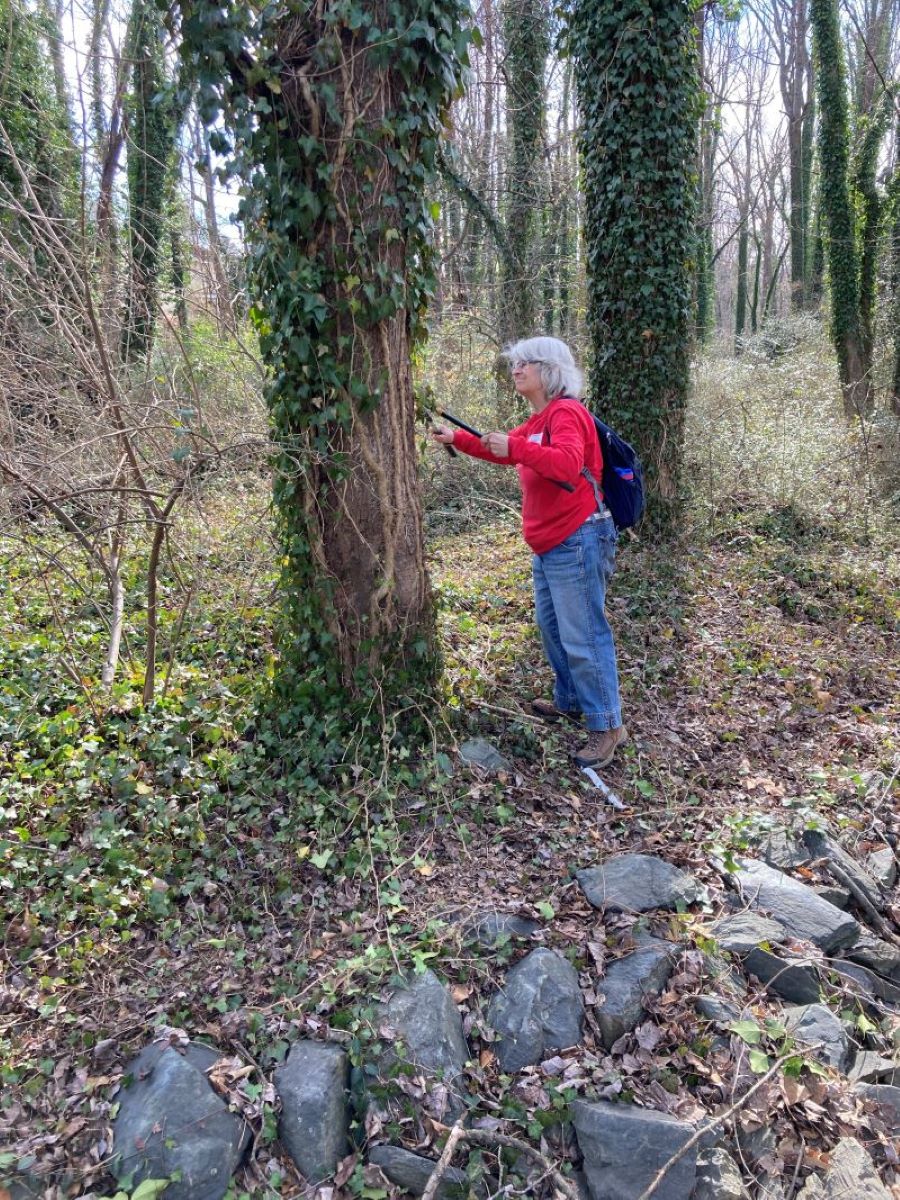
English ivy is one of the species this project will be working to control. English ivy easily escapes yards and infests natural areas.
What you are seeing is the ever-growing problem of non-native invasive plants. Due to their aggressive growth and lack of natural controls, these plants are a serious threat to the health and resilience of our native forests. They also imperil the important environmental and public health benefits forests provide. This is especially true for riparian forests that grow alongside waterways and play an essential role in protecting water quality and stream health. Learn more about invasive plants here.
In recent years, many organizations, local governments, and community members in the Charlottesville area have begun to take action to control invasive plants, largely through volunteer workdays. It has quickly become clear, though, that current efforts are greatly outscaled by the enormity of the problem and the lack of clear priorities and a coordinated approach.
To help address this issue more strategically and on a larger scale, more than a dozen nonprofit organizations, local government agencies, technical experts, and other community stakeholders, are forming a partnership and beginning to work together through a project called the Rivanna River Forest Health and Resilience Project.
Project Overview
The Rivanna River Forest Health and Resilience Project is made possible through a grant from the National Fish and Wildlife Foundation, with support from the U.S. Environmental Protection Agency and the Chesapeake Bay Program. It is a multifaceted project with the goal of improving forest health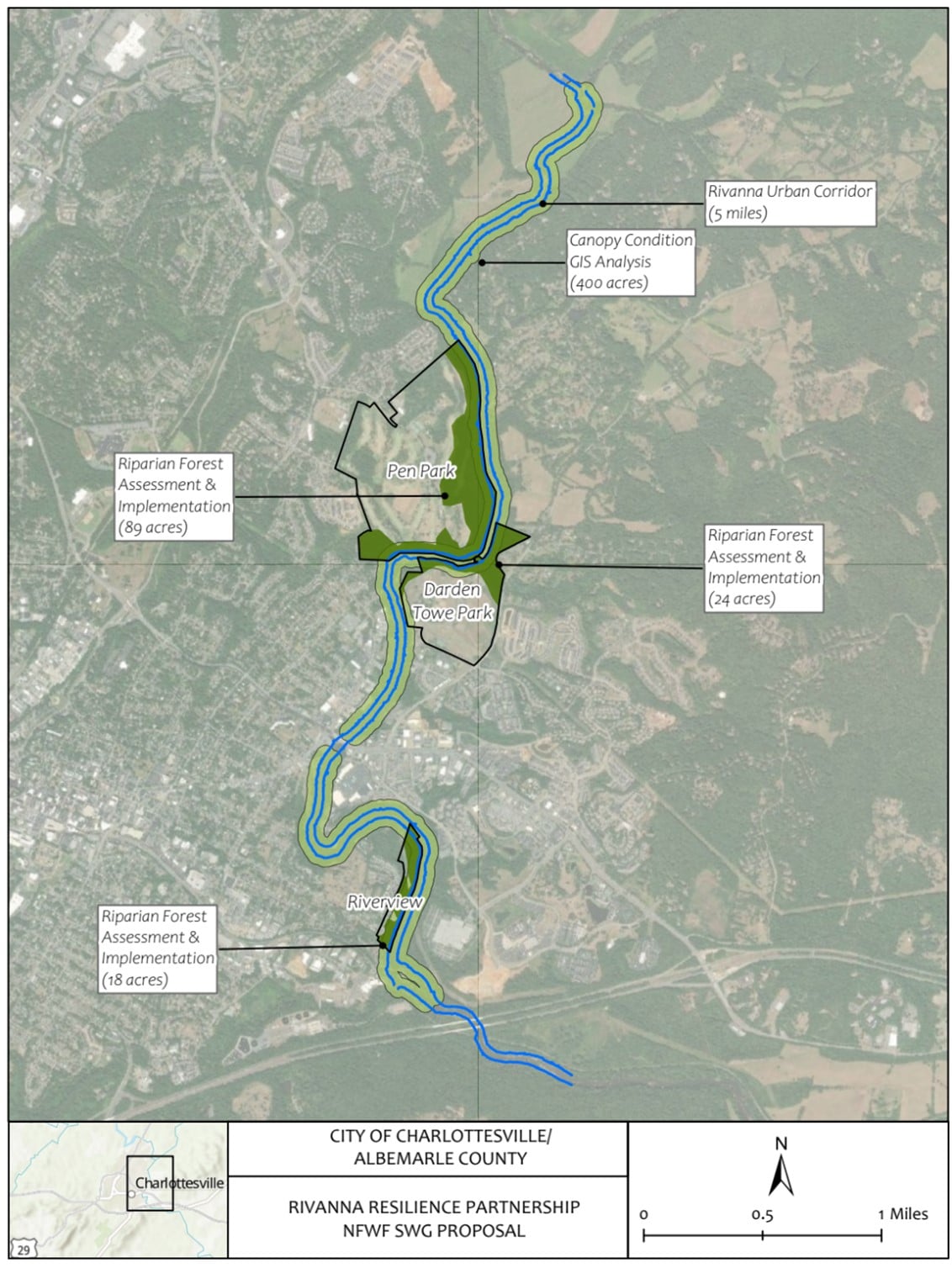 along the urban Rivanna River through the management of high-risk invasive plants and the planting of new native trees. It is a collaborative and coordinated effort to make on-the-ground improvements in forest health, and to motivate and support the wider Rivanna River watershed community to take action on these issues.
The project focuses on the five-mile urban corridor of the Rivanna River, from the confluence of the North and South Forks of the Rivanna down to Moores Creek. It includes activities at two scales:
- Broad scale mapping, outreach and engagement with riverfront property owners, with coordination taking place along the entire five-mile project area.
- Field assessments, forest management planning, invasive plant management, and native tree planting will take place in the three public parks in the project area: Darden Towe, Riverview, and Pen Parks.
Project Components
The project includes a wide range of activities and efforts to help achieve both short- and long-term goals related to improving forest health and resilience in the urban Rivanna River corridor.
- Developing a robust partnership – The project established the Rivanna Forest Restoration Partnership, made up of nonprofits, local governments, technical experts, and other community stakeholders. The Partnership helps guide different aspects of the overall project, including determining the highest priority locations in the three parks for grant-supported invasive management and tree planting efforts. The Partnership will continue to work together after completion of the grant.
- Creating targeted forest management plans – With support from trained volunteers, the project has and will continue to collect field data on current forest conditions, including native tree canopy and prevalence of invasive species. The Partnership uses these data to determine management priorities and to create targeted forest management plans for each park.
- Implementing the highest priority management actions – The grant will support a contractor to work on removing and managing high-risk invasive vines, shrubs, and trees in the highest priority locations. This will be followed up by volunteers planting native tree seedlings in areas where they are most needed.
- Training community members – The project recruits and trains community members to carry out forest health assessments, manage invasive plants, and plant trees.
- Raising awareness and promoting wider scale action – The project includes research into how best to support Rivanna River private property owners in addressing invasive plants and it will create outreach materials and strategies to meet these needs.
What is a “resilient” forest? Forests can experience many different threats and disturbances, including drought, flooding, insect damage, excessive deer browsing, disease, human activity and recreation, and climate change. A resilient forest is one that has the ability to withstand and adapt to these stresses without losing its ecological integrity.
Project Partners and Supporters
Partners
- Rivanna Conservation Alliance
- Blue Ridge PRISM
- ReLeaf CVille
- Thomas Jefferson Planning District Commission
- Charlottesville Parks & Recreation
- Albemarle County Parks & Recreation
- Albemarle County Environmental Services
- The Nature Conservancy
- Charlottesville Area Tree Stewards
- Rivanna Master Naturalists
- Rivanna River Company
- Rivanna Water & Sewer Authority
Supporters
- Rivanna Trails Foundation
- Ecosystem Services
- Thomas Jefferson Soil and Water Conservation District
- Virginia Department of Forestry
- Wild Ginger Field Services
Many other organizations, agencies, and businesses are supporting the project and the Partnership will continue to grow.
Project Timeline
Complete
Spring 2024
- GIS mapping of project area, including detailed mapping of the assessment areas
- Performed assessments to collect field data to inform management plans and priorities
Summer 2024
- Developed targeted Forest Resilience Management Plans for the three parks with prioritized lists of management units to focus on for invasive management and tree replanting
- Performed landowner survey and interviews
Fall – Winter 2024
- Managed invasives in highest priority areas
- Developed outreach materials and strategies
Spring 2025
- Planted 1,800 native trees and shrubs
In progress
Summer 2025 and beyond
- Ongoing coordination and action among members of the Rivanna Forest Restoration Partnership, and ongoing monitoring and management of high priority areas
How to Get Involved
If you are interested in receiving project updates and information on volunteer opportunities, please submit your contact information here.

Protecting trees that grow near the river is important for both forest health and water quality.
Where to Learn More
- Visit the U.S. Forest Service’s Invasive Plants webpage.
- Blue Ridge PRISM Invasive Plants Factsheet
- What Are Invasive Species? – Watch Video
- Little Things, Big Problems — Invasive Plants in Our Parks – Watch Video
- Visit the Rivanna Forest Restoration Partnership website for upcoming volunteer opportunities